RESEARCH VESSEL S/Y OCEANIA
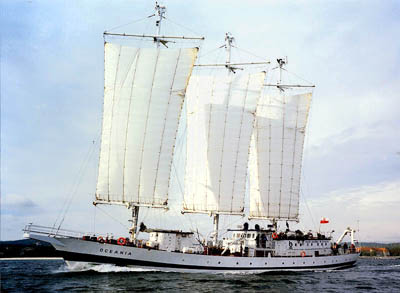


Oceania
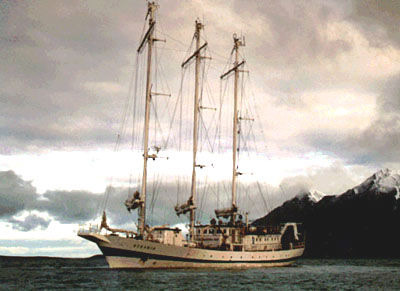
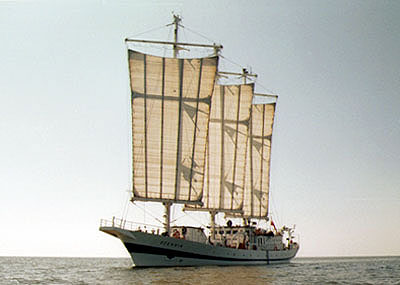
s/y Oceania fot. J. Dabrowski
  1. General information
  2. Rules of usage (in Polish)
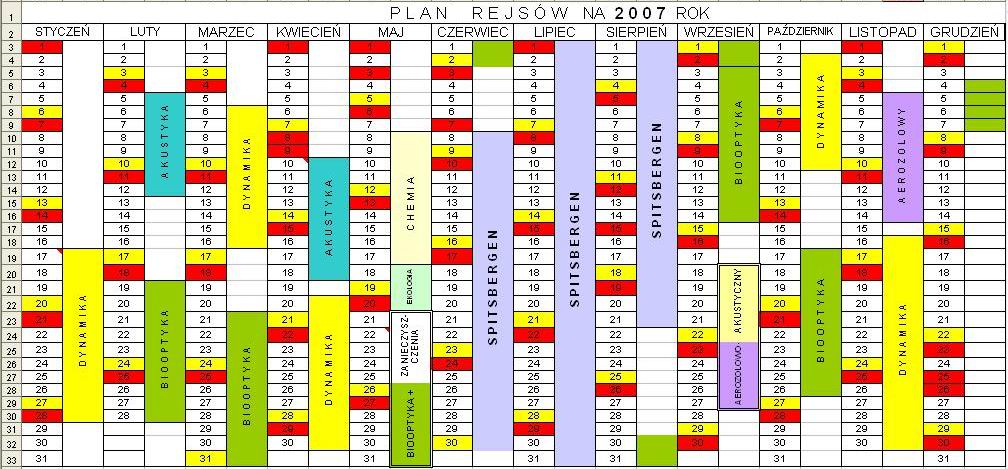
  3. Plan of cruises for 2007 (Polish)
  4. Ship specifications
  5. Research facilities
  6. Standard research operations

1. General information

Name: r/v Oceania
Call sign: SQOC
Owner: Polish Academy of Sciences, Warsaw, Poland
Operator: Institute of Oceanology PAS 81-967 Sopot,
ul. Powstancow Warszawy 55
phone: (++48-58) 51-21-30, 51-72-81
fax : (++48-58) 51-21-30
Personal contacts: dr eng. Jacek Wyrwinski,
dr Andrzej Kadlubicki
Harbour: Gdansk
Construction year: 1985
Cruising range: unlimited,
except the Arctic during winter periods
Endurance: 1 month
Crew: 13
Scientists: 14


2. Ship specifications

2.1 Main features

Displacement: 370 T
Length: 48.9 m
Breadth: 9,0 m
Draught max: 3.8 m
Propulsion: sails 430 m2 raised and driven hydraulically
Auxiliary engine: diesel, 310 HP with controllable pitch propellers, bow thrusters 70 HP
Max speed: 13 knots on sails, 9 knots with engine
Masts: 3, each 32 meters high. Platforms and wiring available for installation and connection of remotely operated measuring equipment.
Fuel vol.: 47 tons
Fresh water capacity: 40 tons in the tank
Electrical supply: 135kVA, (three generators: 50, 50 and 35kVA), 400V, 220V, three phases, 50Hz
Stabilised circuit: UPS: 5 kVA, 220V, 50Hz
Hydraulic system: driving sail winches, A-frame and cranes, windlass and other deck machinery
Oceania
s/y Oceania fot. J. Dabrowski

2.2 Navigational, communication and other supporting equipment

Radars: Furuno FR 1505 DA and Furuno 1830
Position fixing: satellite: GPS 8800 Honeywell-Elac and Magnavox 4102 DECCA: Navstar 2000D
Weather information: a receiver for facsimile weather maps: FURUNO FAX 108L
Radio station: SKANTI
Gyro-compass: Wega and automatic steering system PLATH
Echosounders: Radmor, ATLAS-DESO 20 (33, 210kHz), Honeywell-Elac, LAZ 4700 (30, 50, 210kHz)
Log: electromagnetic, 4601 Radmor
Waste disposal: biological treatment plant, incinerator TECHMET
Work boat: inflatable, crew: 6, Yamaha outboard engine
Rescue boat: inflatable, DSB 420 JRB, Yamaha engine

2.3 Accommodation

Cabins: 13 double cabins - 5 m2, 1 cabin for six persons - 10 m2, 1 single cabin - 8 m2
Each cabin is equipped with radio and protective clothing - overalls for work on deck and survival suits HALI-HANSEN or AQUATA. Cold and warm water in all cabins.
Messroom: for 30 persons - 20 m2
Recreation room: with library, TV, VCR, stereo and bar for 20 persons - 20 m2
Air conditioning: central air conditioning and heating system, additionally electrical radiators during severe conditions
Bathrooms: 5 with showers, a laundry with a washing-machine

2.4 Laboratories

  • wet laboratory on main deck, 20 m2
  • isotope laboratory, 4 m2
  • chemical laboratory, 6 m2
  • electronic workshop and registration room, 10 m2
  • computer compartment, 7 m2

2.5 Infrastructure

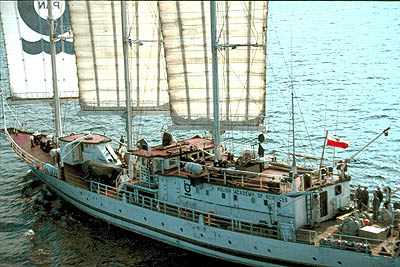
Oceania
s/y Oceania fot. J. Dabrowski
  • A-frame, payload 6 tons, 500 m
  • 2 deep-trawl winches, pull 1 ton, drum capacity 2000 m, (cable wire)
  • four cable wire winches for shallow water uses, pull 150 kg, drum cap. 350 m
  • rosette sampler 12 x 3 litres
  • sediment grab, max operational depth 500 m
  • core sampler for subbottom deposits
  • distillation device
  • dryers, 3 units
  • deep freezes 400 l vol., 2 units
  • refrigerators 2 units, 100 and 200 litres vol.
  • vacuum pump
  • Nansen type sampling bottles, 1 and 2 litres vol.
  • set of plankton nets

3. Research facilities

3.1 Hydrography


3.2 Optics


3.3 Aerosol


3.4 Acoustics


3.5 Chemistry


3.6 Biology


4. Standard research operations

4.1 Physical measurements in situ

  • meteorological measurements conforming the "ship" standard
  • solar radiation
  • vertical wind gradients and air temperature in the near-water layer
  • aerosol concentration and humidity above sea surface
  • vertical profiling of basic properties of seawater and marine environment:
       - temperature and salinity
       - water currents
       - light attenuation at selected wavelengths
       - photosynthetic active radiation, (FAR)
       - light transmission in the sea at selected wavelengths
       - chlorophyll fluorescence
       - sound scattering by the concentrations of fish and plankton
Oceania
s/y Oceania fot. S. Swerpel

4.2 Postprocessing of hydrophysical datasets

  • distributions of sea temperature, salinity and density within the basic scales of their variability: large scale, fine-structure and micro-structure
  • parameters of internal waves
  • vertical distributions of mean velocities of the water flow
  • dynamical height distributions
  • turbulent diffusion coefficients of heat, salinity and passive suspended matter
  • the value and distributions of Brünt-Väisäla parameter and Richardson number
  • dissipation rates within turbulent inhomogeneities of the temperature, salinity and density fields in the sea
  • power spectrum analysis of the temperature, salinity and density fluctuations
  • daily doses of the sun radiation at sea surface and within the water column
  • vertical distribution of light attenuation coefficient at several selected wavelengths
  • diffusive light attenuation coefficients in the sea in the FAR range
  • conditions for sound propagation in the sea
  • wind speed distribution in the air-sea interface layer
  • air humidity and temperature distributions near the sea surface
  • spatial distributions of sea surface temperature and the chlorophyll in the near-surface layer
  • degree of foam coverage of at the free sea surface

4.3 Collection of samples

  • atmospheric aerosols
  • water bottle measurements
  • phyto and zoo-plankton
  • sample fish trawls
  • underway bottom surface sampling using grab samplers
  • near-bottom sediment cores
  • bird watching

4.4 Processing of collected samples

  • distribution of suspended matter in seawater
  • oxygen content
  • pH and alkalinity
  • concentration of nutrients
  • organic and total carbon content
  • concentration of heavy metals
  • composition and distribution of phyto and zoo-plankton populations
  • content of photosynthetic pigments within the plankton, fish and bird communities
  • determination of the content of selected toxic compounds
  • geochemical characteristics of the bottom sediments
  • content of radionuclides in seawater, bottom sediment and live spices
  • content of aromatic organic matter in bottom sediments and marine organisms
  • preconcentration and identification of selected organic compounds extracted from seawater- description of birds, their spatial distribution and number
  • determination of food composition and concentration from the collected organisms
  • primary production


IOPAN Back to IO PAS Home Page