R/V Oceania cruise at the Greenland Sea in 2006
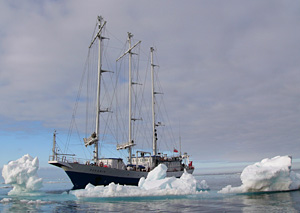
Since 1987 "Oceania" has been travelling from Gdansk, Polish Baltic port, to the Norwegian, Greenland and Barents Sea to perform annual summer experiment in the Arctic. Photo: Anna Drapella
Since 1987 "Oceania" has been travelling from Gdansk, Polish Baltic port, to the Norwegian, Greenland and Barents Sea to perform annual summer experiment in the Arctic. Researchers from the Institute of Oceanology of Polish Academy of Sciences and partners from various countries have been participating in great amount of projects and studies for years.
A lot of oceanographic measurements are performed from the deck of "Oceania". Hydrographic data are gathered from more than 200 stations, from sea surface to the bottom, sometimes four kilometers below. Velocity of sea currents is measured directly by means of acoustic current profilers, meteorological conditions and aerosols are observed continuously, physical and chemical properties of sea water and sedimentation are investigated, biological habitats and variability of sea species are studied.
Measurements are mostly conducted within the Atlantic Domain of the Norwegian and Greenland Sea, between the Barents Sea slope and the system of underwater ridges - Mohns Ridge and Knipovich Ridge. The region of continental slope is especially interesting because of water mixing processes. Svalbard's fjords and troughs near the Bear Island, through which dense winter water drifts from shallow shelf regions to the deep part of the Arctic Seas, are essential for water circulation in the Arctic region. Furthermore, great effort is focused on the northern part of the Atlantic Domain where processes controlling the Atlantic Water inflow into the Arctic Ocean through the Fram Strait and the westward recirculation take place.
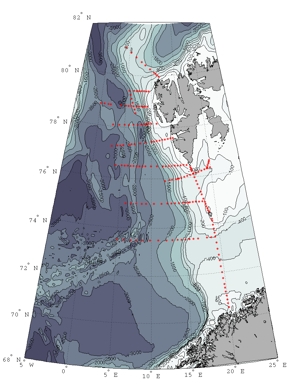
189 hydrographic stations in 13 sections were performed across main core of the West Spitsbergen Current and crosswise and along the continental shelf and slope.
Throughout two and a half summer months "Oceania" sails for thousands of mile s across the marginal Arctic Seas, from Central Europe along Scandinavian Peninsula and Svalbard Archipelago, between sharp mountain peaks, above sea ridges, amongst drift-ices, in fog and storms, mostly during polar day.
In the preceding years "Oceania" took part in the VEINS and ASOF-N projects. This year the ship participates in the European Union's DAMOCLES Project which is an integrated ice-atmosphere-ocean monitoring and forecasting system designed for observing, understanding and quantifying climate changes in the Arctic and has purpose to develop and deploy an advanced observing system that provides for the synoptic, continuous and long-term monitoring of the lower atmosphere, sea-ice and the upper ocean. The project also aims to evaluate and improve global and regional climate forecasting models based on validation by, as well as assimilation and integration of observed data.
"Oceania" has just finished its recent Arctic travel and returned to Poland after nearly three months at sea. The measurements grid spreaded out over an area between northern Norway, the Bear Island and west of Spitsbergen. 189 hydrographic stations in 13 sections were performed across main core of the West Spitsbergen Current and crosswise and along the continental shelf and slope (see map). Several high-resolution (towed CTD) sections at Spitsbergen shelf were made. Velocity and directions of sea currents were measured directly by means of ship-mounted Acoustic Doppler Current Profiler (ADCP) and Lowered Acoustic Doppler Current Profiler (LADCP) lowered with CTD from the ship's deck.
The northernmost station was located above 81 parallel. It was a special situation that this region was free from sea ice. Generally, temperature of Atlantic Water was higher than in previous years and its range was shifted far away to the north.
On the cruise “Oceania” visited Tromso in northern Norway and three times the Longyearbyen port in the Isfjord which is the biggest fjord of Spitsbergen located in the center of the island. Moreover, she explored in detail two Spitsbergen Fjords: Hornsund and Kongsfjorden.
 Back to OCL Page